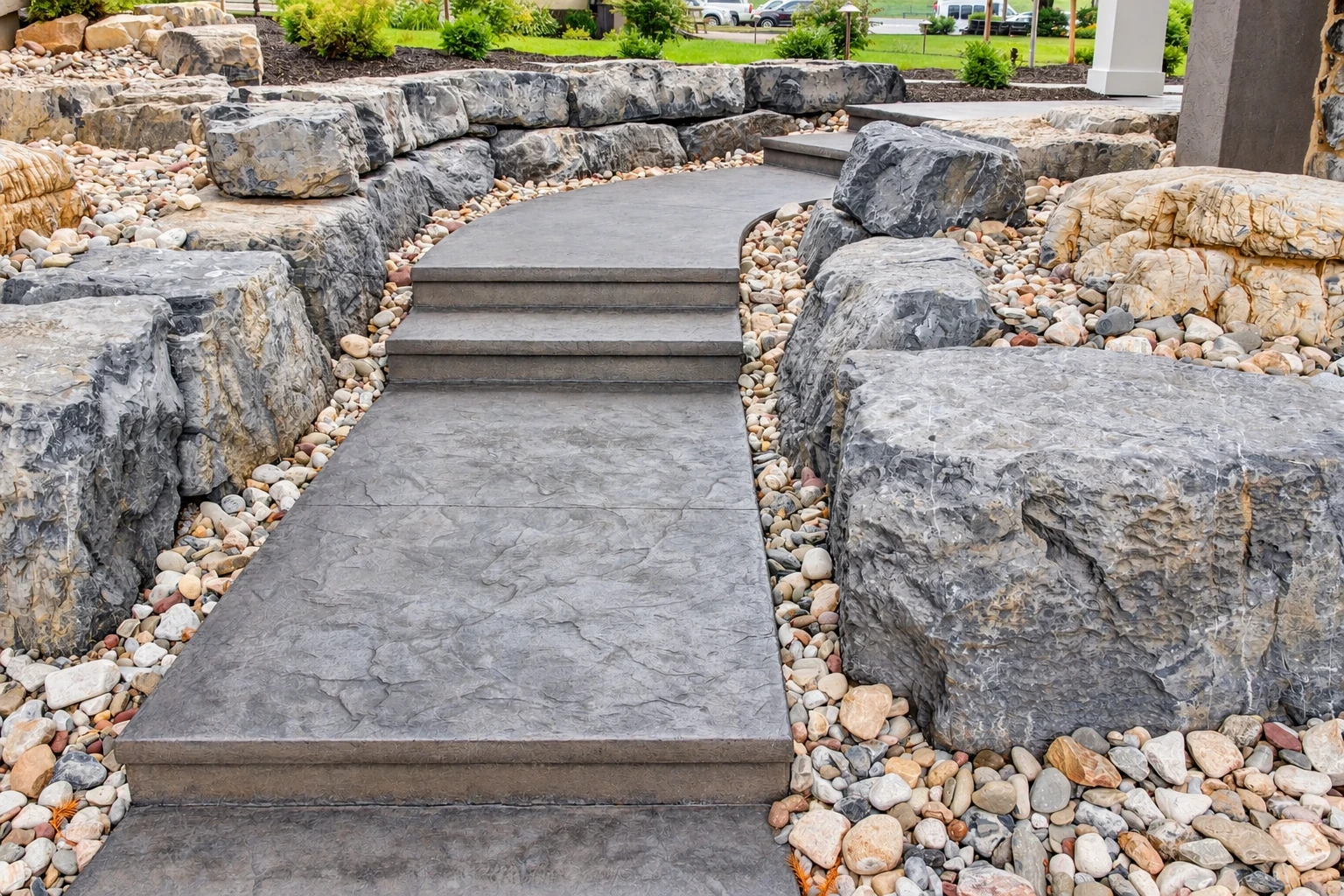
Concrete sidewalk building in Willmar MN - a walk built on a firm, packed base
Cracked, heaved or sunken walk to your door? We dig out, pack the base and pour a new concrete walk that sits flat.
What goes into building a concrete sidewalk in Willmar?
Willmar Concrete builds concrete sidewalks in Willmar, MN by digging out and packing a firm base, then forming, pouring and finishing a new walk that sheds water away from your house.
Most people call when the old walk has cracked, heaved at a joint or sunk so water pools by the door, and the cause is usually underneath, in a base that was raked level instead of dug out and packed. The price moves with the walk's length and width, whether old concrete has to be broken out and hauled away, how much digging the ground needs and the finish you choose, and your written estimate puts each of those on its own line.
The schedule turns on the ground and the weather, because we pour once the frost is out, and on the few days the new walk needs to cure before you use it. If the walk ends at a front stoop that has settled too, I can look at concrete steps on the same visit so the two meet cleanly.
- Tear-out and hauling of the old walk, or stripping sod where there wasn't one.
- A dug-out, packed subgrade, the ground the walk sits on, shaped to shed water from your house.
- Control joints, grooves that give the concrete a planned place to crack, and a broom finish for grip.
What happens after you call about a new sidewalk?
I come out myself to look at the job and write the estimate, and our crew does the forming, pouring and finishing. Here's how it goes from your first call to the finished walk.
Call or send the form
You call (320) 419-1056 or send the form, and I set a time to come out to your house. I'd like to hear what you have in mind for the walk while we look at the ground together.
I look over the site
I walk the route, check where your water runs and how the ground meets the house. You then get a written estimate that lists tear-out, base, concrete and finish separately, so you know exactly what you're paying for and can compare it with other bids.
We form, pour and finish
Once you're ready, we schedule the pour around the ground and the forecast, since the base has to be firm and free of frost. Our crew digs out and packs the base, sets the forms, then pours and finishes the walk.
Walk the finished job together
I walk the finished sidewalk with you before we call it done, and we go over how to protect it while it cures. Satisfaction guaranteed, because it has to be work I'm glad to put our name on.
Concrete walks, patios and slabs at each stage of the work
These photos show the kind of work a concrete walk involves, from forms and fresh pours to finished, broom-textured surfaces. They're examples of the trade, so you can picture each step before I come out.
Curved swimming pool and pale concrete deck bordered by stone walls, patio seating, and a wooded yard.
Concrete patio beside a house, with a broad light-gray slab, dark border, dining set and landscaped mulch beds.
A textured gray concrete pool deck with a rounded edge borders a blue swimming pool beside a patio seating area.
Modern rectangular pool and spa surrounded by a pale tiled concrete deck, with tiered steps and tropical landscaping.
A black SUV parked on a light concrete driveway with dark borders, viewed from above.
A smooth gray concrete driveway with expansion joints leads to two white garage doors, bordered by grass and shrubs.
Get a written estimate for your new sidewalk
Send the walk's rough length and width, what's there now and when you'd like it poured, and we'll reply within one business day to set a time. The on-site estimate is free, with no obligation to book.
(320) 419-1056Questions about building a concrete sidewalk in Willmar
These are the questions I hear most when someone in Willmar is planning a new walk. They cover timing, cost, licensing and how to get a walk that holds up to our winters.
When can a concrete sidewalk be poured in Willmar?
A sidewalk should be poured only once the ground under it is free of frost, so the season opens after the frost is out in spring. Standard Minnesota walk specifications call for clearing snow, ice and frost from the base and placing concrete only on ground that isn't frozen. Frost can leave quickly once it starts, too. At a University of Minnesota research center in spring 2022, frost depth read 36 inches on April 25 and zero on May 2, so we check the ground before we set a pour date.
How much does a concrete sidewalk cost in Willmar?
Across the US, installing a standard broom-finish concrete sidewalk usually costs about $6 to $15 per square foot, and that's the market's range, not our price. Tear-out, extra base work and color or patterns push a walk toward the higher end. Your own figure comes from the written estimate, which prices each part of the job on its own line.
Does my sidewalk contractor need a Minnesota license?
Yes, if they contract directly with you on a home of one to four units and do work in more than one special skill, the Minnesota Department of Labor and Industry requires a residential building contractor or remodeler license. A contractor who offers only one special skill doesn't need a state license and registers with the state instead. The state puts excavation and grading in one skill and concrete slabs in a separate masonry and concrete skill, so it's fair to ask which skills a bid covers. We're licensed and insured.
How long does new concrete need to cure before I can walk on it?
Standard Minnesota walk specifications call for at least 72 hours of curing after finishing, about three days. Through that stretch the walk should be protected from drying out, rain, traffic and extreme heat or cold, so plan to keep people, pets and bikes off it and keep it covered if rain or a hard cold snap is coming.
What causes a concrete sidewalk to flake after winter?
Flaking is usually surface scaling, where the top layer of the concrete peels away, and it's the most common kind of frost damage on concrete. It's linked to de-icing salt use, which is worth keeping in mind when you choose what to spread on a new walk. If an older walk at your house is scaling, I'm glad to look at it and tell you whether it needs replacing.
What is the best way to make a concrete sidewalk hold up to freezing?
The best place to start is a mix with entrained air, a network of tiny bubbles spread through the concrete that can give freezing water room to relieve pressure. For a walk that freezes every winter, ask each contractor whether the quoted mix has entrained air. Ask about it alongside how they prepare the base, since both matter once the cold sets in.
Concrete sidewalk building in Willmar and nearby cities
We're based in Willmar and build walks in Litchfield and nearby cities, often replacing front walks that settled over soft ground. Before we schedule, I check with the city or county, and if a permit applies, we handle the paperwork and inspections.